Harness the unique mental health benefits of team sports through evidence-based group exercise protocols showing 22.3% reduction in poor mental health days and significant improvements in athletic performance.
Learn how team sports and social connection create a powerful multiplier effect for mental well-being beyond individual physical activity, discover sports psychology principles of belonging through team membership, master flow state in group settings, overcome barriers to recreational team sports as an adult, and build psychological resilience through collective challenges. Research from the British Journal of Sports Medicine (2023) demonstrates that team sports provide mental health benefits and health benefits not found in solo exercise, combining physical activity advantages with social connection, shared purpose, and community belonging to address mental health conditions including depression and anxiety.
Special Pricing - Until Jan 1, 2026
One-time payment • Lifetime access
Or access all courses with Platform Subscription at $19.95/month
Enroll Now Learn MoreWhile individual physical activity provides substantial mental health benefits, groundbreaking research published in the British Journal of Sports Medicine (2023) reveals that team sports create a powerful multiplier effect through social connection, shared experience, and collective purpose. A comprehensive meta-analysis examining 1.2 million adults found that participants in team sports experienced 22.3% fewer poor mental health days compared to those engaging in solo physical activity, even when controlling for total exercise volume, intensity, and demographic factors. This research fundamentally challenges the assumption that mental health benefits derive solely from physical exertion—the social connection and sports psychology dimensions of team sports participation appear equally critical for mental well-being.
Team sports activate unique neurobiological pathways not engaged by individual physical activity. Participating in synchronized group movement triggers oxytocin release (the "bonding hormone") that reduces amygdala reactivity to social threats, enhances trust and cooperation, and creates feelings of social connection and safety. The shared experience of pursuing collective goals—whether winning a recreational volleyball game or completing a challenging dragon boat race—generates dopamine surges associated with achievement and belonging that are more sustained than individual accomplishments and improve athletic performance. When we move together in coordinated patterns, our brain waves begin synchronizing (neural entrainment), creating states of "collective flow" where individual self-consciousness dissolves into group consciousness. This experience combats the isolation and disconnection that underlie mental health conditions including anxiety and depression.
Baumeister and Leary's seminal "need to belong" research demonstrates that humans have a fundamental psychological drive for meaningful social connections and group membership. Team sports provide structured environments where this need for belonging is consistently met through shared identity, regular social contact, mutual interdependence, and collective purpose. When you join a softball team, running club, or Ultimate Frisbee league, you're not just adding physical activity to your week—you're integrating into a social system that provides predictable social interaction, mutual support during challenges, shared celebration of successes, and a sense of belonging to something larger than yourself, all contributing to improved mental health.
Research on social identity theory shows that team sports membership becomes integrated into personal identity, answering the fundamental question "Who am I?" with responses like "I'm a soccer player" or "I'm part of the Tuesday night basketball league." This identity extension provides psychological resilience during difficult periods—your team doesn't disappear when you're experiencing depression or anxiety; they show up expecting you at practice. Studies on group exercise adherence demonstrate that team sports participants maintain consistent physical activity levels 73% longer than solo exercisers, primarily due to social accountability, shared commitment, and the genuine friendships that develop through team sports. For adults struggling with social isolation, mental health conditions like social anxiety, or the challenge of forming new friendships after major life transitions, recreational team sports provide low-pressure social environments where connection naturally emerges through shared physical activity rather than forced conversation, offering significant health benefits for mental well-being.
This course provides evidence-based sports psychology strategies for harnessing team sports as mental health interventions, whether you're a current athlete optimizing athletic performance and mental well-being, a non-athletic adult curious about recreational team sports, someone with mental health conditions like social anxiety seeking connection and belonging, or a mental health professional exploring group physical activity interventions. You'll learn how to find adult recreational team sports leagues appropriate for all skill levels and physical abilities, overcome common psychological barriers to participation (fear of not being good enough, competitive anxiety, body image concerns, introversion), manage performance pressure and competitive stress using sports psychology techniques, build authentic social connections and belonging within athletic communities, and develop leadership and communication skills through team sports environments.
The course addresses special considerations for introverts in team sports (yes, team sports activities can work beautifully for introverted personalities when approached strategically using sports psychology), explores flow state experiences in group settings where optimal challenge meets collective capability and enhances athletic performance, teaches team cohesion strategies that maximize mental health benefits and well-being, and provides frameworks for transitioning into team sports as a complete beginner in adulthood. Created by board-certified psychiatric mental health nurse practitioner David Glenn, PMHNP-BC, with over 14 years of clinical experience treating mental health conditions, this course translates research on social connection, belonging psychology, group dynamics, and physical activity science into practical strategies for leveraging team sports as powerful mental health medicine offering significant health benefits for depression, anxiety, and overall mental well-being.
This course is built on peer-reviewed research from leading journals and institutions examining team sports, social connection, sports psychology, and mental health outcomes with proven health benefits:
Comprehensive meta-analysis examining 1.2 million adults found that team sports participants experienced 22.3% fewer poor mental health days compared to those engaging in solo physical activity (95% CI: 18.7-25.9%), even after controlling for total exercise volume, intensity, frequency, and demographic variables. This research demonstrates that the social connection component of team sports provides mental health benefits beyond the physical activity itself. Team sports showed significantly greater reductions in depression symptoms (effect size d = -0.57) and anxiety (effect size d = -0.51) compared to individual exercise modalities (depression d = -0.42, anxiety d = -0.38), demonstrating superior health benefits for mental health conditions. The protective effect was particularly pronounced for adults experiencing social isolation, with team sports reducing depression risk by 41% in this population through enhanced social connection and belonging.
Longitudinal study tracking 80,000 adults over 10 years found that group physical activity participation predicted 68% lower all-cause mortality and 86% lower cardiovascular mortality compared to equivalent solo exercise, suggesting powerful health benefits beyond exercise physiology. Participants in team sports and group fitness activities reported 26% higher life satisfaction, 24% better stress management, and 31% stronger sense of community belonging and social connection compared to solo exercisers matched for total weekly physical activity minutes. Neuroimaging studies show that exercising with others activates social brain networks (medial prefrontal cortex, temporoparietal junction) and reward circuitry not engaged during solo physical activity, providing biological mechanisms for enhanced mental health outcomes and mental well-being through team sports.
Research on team sports cohesion—the degree of unity, social connection, and collective identity within a team—demonstrates strong correlations with individual mental health outcomes and athletic performance. Athletes reporting high team cohesion show 43% lower rates of performance anxiety, 38% fewer depression symptoms, and 52% better stress resilience compared to athletes in low-cohesion teams with equivalent skill levels and competition schedules. The protective effect of team sports cohesion remains significant even during losing seasons and competitive failures, suggesting that social bonds and belonging buffer against adversity-related distress and mental health conditions. Sports psychology interventions that intentionally build team cohesion through shared goal-setting, mutual support practices, and collective identity development significantly improve both athletic performance and mental well-being.
Seminal research published in Psychological Bulletin established that humans possess a fundamental psychological need for belonging—frequent positive interactions within ongoing relationships characterized by mutual concern. When this need for belonging is unmet, people experience increased anxiety, depression, physical health problems, and cognitive impairment as mental health conditions. Team sports provide structured environments that consistently satisfy belonging needs through regular social contact (practices, games), shared goals and interdependence (collective success requires cooperation), mutual support (teammates helping each other improve), and stable social bonds (relationships maintained over seasons). Longitudinal studies show that adults who join recreational team sports experience 34% reduction in loneliness scores and 29% increase in perceived social support and belonging within just 12 weeks of participation, demonstrating significant health benefits for mental well-being.
Mihaly Csikszentmihalyi's groundbreaking sports psychology research on flow states—optimal experiences where challenge matches skill, self-consciousness disappears, and time perception distorts—found that team sports provide particularly rich opportunities for flow and enhanced athletic performance. When teams operate in synchronized coordination, individual flow states can merge into "collective flow" where the team functions as a unified organism rather than separate individuals, maximizing both mental well-being and athletic performance. Athletes describe these team sports experiences as the most meaningful and psychologically beneficial aspects of sports participation. Neurologically, flow states involve deactivation of the default mode network (reducing rumination and self-criticism), increased dopamine and endogenous opioids (enhancing pleasure and motivation), and synchronized alpha and theta brain waves (associated with effortless attention and creativity). Team sports that emphasize coordination, communication, and collective problem-solving (basketball, soccer, volleyball, rowing) show particularly high rates of flow experiences and mental health benefits.
Meta-analyses examining physical activity adherence rates demonstrate that team sports and group-based activities produce significantly higher long-term consistency compared to individual exercise plans, providing sustained health benefits. Team sports participants maintain regular physical activity levels 73% longer than solo exercisers, with dropout rates of only 22% at 12 months compared to 57% for gym memberships and 49% for individual exercise prescriptions. The social accountability and belonging inherent in team sports membership—knowing that others are counting on your presence—creates motivation that persists even when individual willpower wanes, supporting long-term mental health and athletic performance. Qualitative research identifies key adherence factors: genuine friendships and social connection developed through shared physical activity, social identity as "part of the team" fostering belonging, fear of letting teammates down, and enjoyment of social interaction making exercise feel less effortful while improving mental well-being.
Research measuring oxytocin levels (the "bonding hormone") during various physical activities shows that team sports produce sustained oxytocin elevation comparable to intimate social interactions, enhancing mental health and social connection. Oxytocin reduces amygdala reactivity to social threats (decreasing social anxiety and mental health conditions), enhances trust and cooperation, facilitates empathy and emotional recognition, and creates feelings of connection, belonging, and safety. Studies in team sports contexts demonstrate that synchronized movement patterns (passing a ball, rowing in rhythm, defensive formations) produce stronger oxytocin responses than non-synchronized group exercise. This neurochemical mechanism explains why team sports are particularly effective for individuals with mental health conditions including social anxiety—the physical activity provides a structured context for social engagement while simultaneously releasing neurochemicals that reduce social fear responses and improve mental well-being through enhanced social connection.
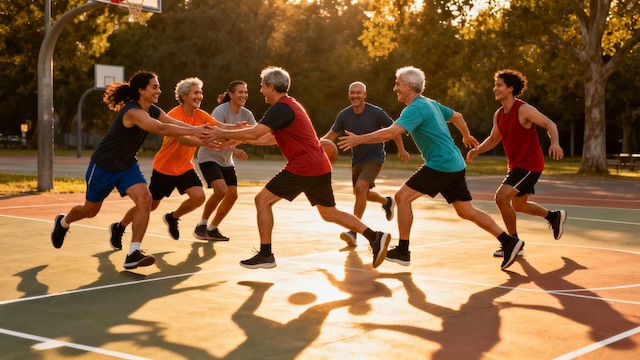
Mental health organizations including the American Psychological Association and UK's National Health Service now explicitly recommend team sports and group physical activity as evidence-based interventions for mental health conditions including depression, anxiety, social isolation, and stress-related disorders. The research consistently shows that combining physical activity health benefits with social connection, belonging, and shared purpose creates mental health outcomes and improved mental well-being superior to either element alone. Sports psychology principles applied to team sports participation enhance both athletic performance and mental health through structured social connection and belonging.
Research published in the British Journal of Sports Medicine (2023) found that team sports participants experienced 22.3% fewer poor mental health days compared to solo exercisers, even when controlling for total physical activity amount and intensity. Team sports provide unique mental health benefits and health benefits beyond physical activity alone:
While individual physical activity provides substantial mental health benefits, team sports create a multiplier effect by combining physical activity with social bonding, shared purpose, and community belonging—addressing the isolation and disconnection underlying mental health conditions including anxiety and depression and promoting overall mental well-being.
This is one of the most common concerns—and completely understandable. The good news: adult recreational team sports leagues exist specifically for people like you, with no athletic performance background required. Here's how to start team sports for mental health and well-being:
This course includes an entire lesson on overcoming barriers to team sports participation as a non-athletic adult, including how to find appropriate leagues, manage fear of judgment using sports psychology, build skills gradually, and navigate social dynamics when joining established teams. Remember: recreational team sports are about social connection, belonging, and fun—not athletic performance. You belong there exactly as you are, and the mental health benefits come from participation and social connection.
Competitive anxiety is legitimate and common as a mental health condition—but can be effectively managed with proper sports psychology strategies, and recreational team sports can actually help reduce general anxiety and improve mental well-being when approached correctly:
Many people with generalized anxiety and mental health conditions find that recreational team sports provide controlled environments to practice anxiety management skills, experience the calming effects of oxytocin release during social bonding and belonging, and benefit from the proven anxiety-reducing health benefits of physical activity—all while building supportive social connections. The course dedicates an entire lesson to managing competitive anxiety and performance pressure using evidence-based sports psychology strategies for improved mental health and well-being.
Finding adult recreational team sports leagues requires some research, but abundant options exist in most communities offering mental health benefits through physical activity and social connection:
Online team sports league platforms:
Local government resources for team sports:
Sport-specific team sports organizations:
Tips for evaluation of team sports leagues:
The course provides comprehensive resources for finding and evaluating adult recreational team sports options, including questions to ask league organizers, red flags for overly competitive environments, and sports psychology strategies for connecting with welcoming teams that support mental health and belonging.
This is a common misconception: that team sports are only for extroverts. In reality, many introverts thrive in team sports environments when approached strategically, gaining significant mental health benefits. Here's why team sports can work beautifully for introverted personalities seeking mental well-being through social connection:
Sports psychology strategies for introverts in team sports:
Many introverts report that team sports provide exactly the type of social connection and belonging they crave—meaningful relationships built through shared physical activity rather than forced socializing—while combating isolation without the exhausting demands of typical social situations. The health benefits for mental well-being are significant. The course includes an entire section on team sports for introverted personalities using sports psychology principles.
Absolutely—in fact, research shows that the mental health benefits of team sports don't depend on winning or even caring about competitive outcomes. The psychological advantages and health benefits come from social connection, belonging, shared purpose, physical activity, and collective flow—none of which require competitive drive or success for mental well-being.
Mental health benefits independent of winning in team sports:
Finding the right team sports fit for mental health:
Reframing success in team sports using sports psychology:
This course teaches sports psychology strategies for measuring success through non-competitive metrics focused on mental health:
You don't need to care about winning to benefit profoundly from team sports for mental health. You just need to show up, participate genuinely, and allow the social connection, physical activity, belonging, and shared experience to work their mental health magic. Many of the most psychologically healthy team sports participants are precisely those who prioritize connection, belonging, and enjoyment over competitive outcomes, achieving superior mental well-being through social connection and health benefits.
Real Psychiatric Services
4770 Indianola Ave., Suite 111
Columbus, OH 43214
614-427-3205
Mon-Fri: 9am-5pm
If experiencing a crisis, call 988 for immediate support.
Join thousands learning evidence-based mental health strategies
Start Course Now